Company: Hawkeye Physicians PLLC
Industry: Teleradiology Services
Location: New York, United States
Use Case: Automating physician credentialing applications across multiple hospital facilities
Forms Automated: Hospital credentialing packets (initial applications, reappointments, privilege requests)
Challenge: Managing complex, facility-specific credentialing requirements for multiple radiologists across numerous hospital contracts
Solution: Instafill.ai for automated form filling, PDF conversion, and credentialing workflow management
Executive Summary
A U.S.-based teleradiology practice needed a faster, more reliable way to complete hospital credentialing packets for radiologists working across multiple facilities. While each hospital’s packet format differed, the underlying information was largely the same – work history, licensure, board certification, affiliations, malpractice coverage, and privilege requests. The practice’s coordinator was repeatedly re-entering the same details into long documents, then re-checking for formatting and consistency.
Instafill.ai helped them standardize credentialing into a repeatable workflow: collect physician data once, convert flat documents into interactive fillable forms, then generate submission-ready PDFs for initial appointments and renewals. The result was a process designed to reduce repetitive manual entry and make credentialing easier to scale without adding admin headcount.
About Hawkeye Physicians PLLC
Hawkeye Physicians PLLC is a New York-based teleradiology practice supporting hospital partners with diagnostic reads (e.g., X-ray, CT). As part of operations, physicians complete extensive credentialing packages for every hospital they contract with. These packages are often multi-page and vary by facility, even though the underlying information is largely the same.
The Forms
Across the workflow, the practice dealt with multi-page medical staff applications, privilege delineation sheets, reappointment packets, and onboarding/new hire documentation, such as:
- Medical Staff Appointment / Privileges Application – includes personal information, licensure/DEA, education, training, affiliations, liability coverage, sanctions, CME, etc.
- Application for Reappointment to the Medical Staff – personal info, staff status, licensure, board certification, affiliations, sanctions, emergency training, etc.
- MD/DO Radiology – Clinical Privileges – a privileges checklist including diagnostic radiology modalities and requested procedures.
They also maintained a growing internal library of site-specific packets, many of which needed conversion into fillable PDFs before automation.
The Teleradiology Credentialing Challenge
Teleradiology practices often contract with numerous hospitals, particularly for overnight coverage, resulting in credentialing becoming a recurring operational bottleneck. Credentialing departments require extensive documentation to confirm a physician’s identity, training, work history, and privileges; each hospital has its own specific packet structure. In this case, the coordinator managed credentialing workflows across many hospitals, with initial packets being the heaviest lift and annual renewals being lighter but still repetitive.
Hawkeye Physicians PLLC provides teleradiology services, enabling hospitals to access specialized radiology expertise remotely. While this model offers tremendous flexibility for both providers and facilities, it creates a unique administrative burden: every radiologist must be fully credentialed at every hospital where they provide services.
Unlike a traditional radiology practice where physicians are credentialed at one or two facilities, teleradiology requires maintaining active credentials across numerous hospitals simultaneously. Each facility has:
- Different credentialing applications
- Unique privilege delineation forms specific to their imaging capabilities
- Varying documentation requirements
- Different reappointment cycles (annually, biannually, or every two years)
- Facility-specific attestations and policy acknowledgments
- State-specific regulatory requirements
For a teleradiology practice managing multiple radiologists across multiple states and dozens of hospital contracts, this translates to hundreds of credentialing packets annually – with each packet requiring meticulous accuracy, as errors can delay patient care and revenue.
The Manual Process
Before implementing Instafill.ai, Hawkeye Physicians’ credentialing workflow was entirely manual:
1. Form Collection & Management
Each hospital sent credentialing packets in different formats:
- Some as fillable PDFs
- Many scanned, non-fillable PDFs
- Others as Word documents or paper forms, requiring printing
2. Data Entry Across Multiple Systems
For each credentialing packet, staff had to manually:
- Open the physician’s master credentialing file
- Reference multiple source documents (CV, medical education transcripts, license certificates, malpractice history, board certifications)
- Type or copy-paste hundreds of fields, including:
- Personal information (name, DOB, SSN, addresses)
- Education history (medical school, internship, residency, fellowship — with dates, addresses, program directors)
- License information (multiple states, DEA, NPI)
- Hospital affiliations (past 15 years of practice locations)
- Professional liability history (10 years of coverage details)
- CME credits (50+ certificates for 2-year periods)
- References (5+ professionals with contact details)
- Disclosure questions (20+ yes/no questions requiring explanations)
3. Facility-Specific Variations
Despite requesting similar information, each hospital’s forms presented unique challenges:
Example: Medical Education Section
- Adirondack Medical Center requires: Medical school name, full address, dates attended, degree date, ECFMG number if applicable
- Nathan Littauer Hospital requires: Same information PLUS program director names, phone numbers, and fax numbers for every training program
- Other facilities may require clinical rotation logs or additional attestations
Example: Privilege Requests
- Radiology privileges vary by the imaging equipment available at each facility
- Some hospitals have detailed privilege forms with 30+ specific procedures
- Others use simplified core privilege models
- Each requires documentation of training and recent case experience
4. Quality Control & Submission
After completing forms:
- Manual review for accuracy
- Assembly of supporting documents (licenses, certificates, CME records)
- Coordination of signatures and attestations
- Submission via mail, fax, or facility-specific portals
Time per credentialing packet: 3-4 hours minimum
Error risk: High – a single typo in a date or license number could delay approval by weeks
The Instafill.ai Solution
Hawkeye Physicians implemented an AI form filler to automate their credentialing workflow. The implementation addressed both immediate needs and ongoing process improvements.
Implementation
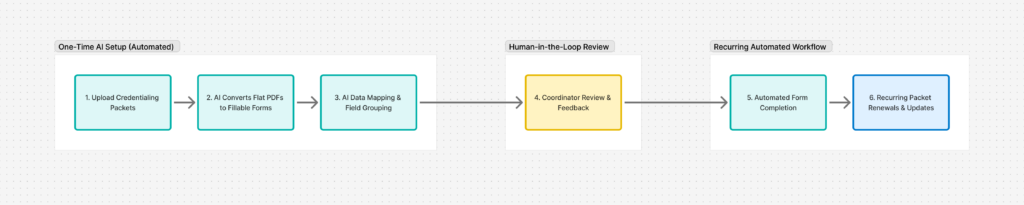
Phase 1: PDF Conversion and Form Preparation
Many hospital credentialing forms arrived as non-fillable PDFs – scanned documents that couldn’t be filled electronically. Instafill.ai’s PDFs to fillable forms converter transformed these into fillable PDFs:
Forms Converted Include:
- Nathan Littauer Hospital Medical Staff Application
- Adirondack Medical Center Application
- Multiple reappointment packets
- Radiology privilege delineation forms
- Payer enrollment packets
- Pre-application questionnaires
This conversion created a library of consistently formatted, electronically fillable forms that could be processed through automation.
Phase 2: Master Data Repository & Automated Form Filling
For each radiologist, Hawkeye Physicians maintains a comprehensive master credentialing profile containing:
- Demographic Data: Current and historical addresses, contact information, citizenship status
- Education & Training: Complete medical education history with all required details (institutions, dates, program directors, addresses)
- Licensure: All state medical licenses (current and historical), DEA registrations, NPI numbers
- Board Certification: Dates, specialties, certificate numbers
- Professional History: Complete chronology of all professional activities since medical school graduation
- Affiliations: All hospital and institutional affiliations for the past 15 years
- Liability Coverage: Current and historical professional liability insurance (10 years), including policy numbers, limits, and carrier contact information
- Malpractice History: Complete disclosure information for any claims or settlements
- References: Professional references with complete contact details
- CME Documentation: Organized library of continuing medical education certificates
- Certifications: ACLS, BLS, and other required training certificates
Instafill.ai uses this master data to automatically populate any credentialing form, regardless of the facility.
Phase 3: Field mapping & review
After fine-tuning, the AI identified fields and grouped related items for fast, accurate completion. Hawkeye Physicians’ credentialing coordinator reviewed outputs and used Instafill.ai’s accuracy improvement tool to flag any misfilled fields. The Instafill team promptly adjusted mappings until reliable results were achieved.
The Automated Workflow
When credentialing is needed at a new facility or for reappointment:
- Form Selection: Staff identifies the required credentialing packet
- Automated Population: Instafill.ai pulls from the master profile and fills all applicable fields
- Facility-Specific Customization: Staff reviews and adds any facility-unique information
- Supporting Documents: Automated assembly of required attachments
- Quality Review: Quick verification of populated data
- Submission: Electronic or physical submission as required
Time per credentialing packet: Under 30 minutes (from 3-4 hours manual)
What Hawkeye Physicians Used
- Flexible Data Input: Supports multiple formats including PDFs (fillable and non-fillable), Word documents, Excel and CSV files, scanned images, and free-form text or JSON. The AI intelligently extracts and maps data regardless of source format, and can blend multiple inputs simultaneously.
- Initial Form Parsing & Fine-Tuning: Instafill.ai runs a one-time fine-tuning process to understand the structure and logic of each form, converting flat PDFs into fillable documents and fine-tuning field mappings for high accuracy (>99%) on subsequent fills.
- Advanced Table and List Handling: The platform reconstructs complex tables and lists, handles dependencies and conditional logic, fills variable numbers of rows, and manages multi-page overflow content with continuation sheets.
What Changed for the Business
Instafill.ai helped Hawkeye Physicians PLLC cut credentialing time from days or hours of manual work to minutes without sacrificing accuracy. The time savings alone are significant. What took three to four hours per credentialing packet now takes under 30 minutes, automatically and consistently. That’s an 85% reduction in time spent on one of the most tedious but critical administrative tasks in teleradiology. But the impact goes beyond just speed.
This acceleration reduced errors and administrative load, allowing the credentialing coordinator to focus on hospital relations rather than repetitive form-filling. As a result, packet renewals and updates are completed more uniformly, improving overall workflow reliability.
The credentialing staff can now focus on work that actually requires human judgment and relationship management. Instead of spending their days typing information into forms, they’re building relationships with medical staff offices at the hospitals Hawkeye Physicians serves.
From a scalability standpoint, this automation has made growth possible without proportional growth in administrative staff. If they want to add another radiologist to the team, the credentialing burden doesn’t increase by much because the process is so efficient. If they want to contract with additional hospitals, the same thing. The system can handle the volume. This is the kind of operational leverage that’s hard to achieve with manual processes.
Looking Forward: Continuous Improvement
Hawkeye Physicians continues to expand their use of Instafill.ai:
- Adding new facilities as they establish new hospital contracts
- Automating payer credentialing for insurance network participation
- Streamlining privilege updates when radiologists complete new training
- Managing state licensing requirements across multiple jurisdictions
- Tracking expiration dates for proactive renewal management
Why This Matters for Other Teleradiology Practices
The challenges Hawkeye Physicians faced are universal in teleradiology:
- Multi-facility credentialing burden – every practice faces hundreds of forms annually
- Facility-specific variations – no two hospitals use identical credentialing processes
- Data consistency requirements – any discrepancy between applications can raise red flags
- Time-sensitive processing – delays in credentialing directly impact the ability to provide services and generate revenue
- Limited administrative resources – credentialing staff are often overwhelmed
Instafill.ai provides a scalable solution that grows with the practice, regardless of size.
Related case studies: