
Company: Hong LLC
Location: Minnesota, United States
Industry: Immigration law
Use Case: Automating preparation of multiple U.S. immigration forms (work permits, adjustment of status, family‑based petitions and payment authorisations)
Primary Forms: I‑765 (Application for Employment Authorization), I‑485 (Application to Register Permanent Residence or Adjust Status), I‑130 (Petition for Alien Relative), G‑1650 (Authorisation for ACH Transactions)
Volume: Several client matters per month, each requiring 3–4 USCIS forms and supporting documents
Time Savings: 75-80% reduction in form completion time
Executive Summary
Sung Woo Hong, founding attorney of Hong LLC in Minneapolis, took an unconventional approach when launching his immigration law practice. Rather than starting with traditional case management software and gradually adding automation, he built his firm around AI-driven form processing from the beginning. By implementing Instafill.ai, Hong LLC created a modern practice infrastructure designed for efficiency rather than retrofitting automation into existing manual workflows.
About Hong LLC
Hong LLC is a boutique immigration law firm founded by attorney Sung Woo Hong in Minneapolis, Minnesota. As a newly established practice, the firm handles employment-based immigration, family-based petitions, and adjustment of status applications.
Hong LLC brought both legal expertise and a clear operational philosophy to its practice. During the initial consultation, Mr. Hong explained his approach:
“I’m trying to create and design a very efficient and automated AI-driven system.”
This wasn’t about adopting technology for its own sake. It was about building a practice that could compete effectively from day one without the administrative bottlenecks that typically constrain solo practitioners.
The Challenge
Immigration practice generates a steady stream of government forms. Each case typically requires multiple USCIS forms, ranging from 6 to 20+ pages. The same client information must be entered repeatedly across different applications. For a solo practitioner, this creates a direct trade-off between time spent on administrative work and time available for legal strategy, client consultations, and business development. Completing these forms manually is laborious:
- High‑volume repetitive data entry. The same biographical information (names, addresses, dates of birth, prior entries) must be entered repeatedly across multiple USCIS forms and pages. Manual entry invites typographical errors and inconsistent formatting.
- Document extraction. Client intake involves collecting passports, driver’s licences, visas and other identification. Extracting data from these documents and retyping it into forms adds another layer of administrative work.
- Form updates and versioning. USCIS regularly updates its forms; practitioners must ensure they are using the latest version or risk rejection. Some clients still require older editions for cases filed under previous rules.
- Security and confidentiality. Immigration cases involve sensitive personal data. Mr. Hong needed assurances that any automated solution would encrypt client information in transit and at rest, and allow for secure deletion once filings were complete.
- Integration with intake workflows. Collecting structured client data via online questionnaires and transferring it into USCIS forms without manual copying remained an open question.
The Solution
Hong implemented an AI form filler as the foundational technology for form processing, building his entire client workflow around AI-driven automation rather than attempting to retrofit automation into existing manual processes.
Instafill.ai’s approach to USCIS forms addressed each layer of immigration documentation complexity:
Client data extraction
- Upload client identification documents (passports, driver’s licenses, birth certificates)
- AI extracts biographical information, dates, document numbers
- Eliminates manual transcription errors from handwritten or foreign-language documents
- Handles various document formats and quality levels
Cross-form consistency
- Client information entered once, used across all applications
- Biographical data auto-populates consistently
- Address history, employment records, education are maintained centrally
- Family relationships are mapped and reused across petitions
Reusable client profiles
The firm created reusable data profiles in Instafill.ai for each client, storing recurring details such as name, address, date of birth, Social Security number, contact information, etc. Supporting documents, including passports and driver’s licences, were attached to the profile. The AI extracted text from these images and PDFs, standardised formatting and populated the corresponding fields in the immigration forms. This eliminated manual transcription while preserving accuracy.
Rapid form filling
Once profiles were set up, Hong LLC could generate complete form packets in seconds. For immigration filings, the firm selected the desired form, chose the client profile and filled out the form. Instafill.ai automatically inserted the extracted data, checked appropriate boxes, and formatted dates according to USCIS requirements. What previously took hours of manual work now occurred almost instantly.
The Impact
| Form | Manual Time | With Instafill.ai | Time Saved |
|---|---|---|---|
| I-485 (Adjustment of Status) | 90–120 minutes | 20–25 minutes | 70–80% |
| I-765 (Employment Authorization) | 30–45 minutes | 8–10 minutes | 75–80% |
| I-130 (Family Petition) | 45–60 minutes | 10–15 minutes | 75–80% |
| G-1145 (E-Notification) | 5–10 minutes | 2–3 minutes | 60–70% |
| Typical family case (3 forms) | 3–4 hours | 45–60 minutes | ~75% |
Operational advantages for solo practice
Increased Capacity
- Handle 2-3x more cases without additional staff
- Time saved redirected to client consultations and legal strategy
- Ability to accept more clients without compromising service quality
Professional presentation from day one
- Error-free, professionally completed forms
- Consistent formatting across all applications
- Builds client confidence in new practice
- Competitive with established firms from launch
Scalability built-in
- System handles increased volume without additional setup
- No need to train staff on form completion
- Growth doesn’t require proportional administrative hiring
- Technology infrastructure ready for multi-attorney expansion
Client experience
- Faster application processing
- Reduced errors mean fewer USCIS delays
- More attorney time available for case strategy and updates
- Modern, tech-forward firm image
Security for Sensitive Immigration Data
Immigration cases involve highly sensitive personal information:
- Social Security numbers
- Passport and visa information
- Financial records
- Criminal history (if applicable)
- Medical information
- Family relationships and addresses
Instafill.ai’s security infrastructure addresses these concerns:
- Encryption: Data is encrypted both in transit (HTTPS) and at rest. Client information is stored encrypted on servers.
- U.S.-based hosting: Servers are located in Texas, operated by Microsoft. Data doesn’t transfer internationally.
- No AI training: Client data is never used to train AI models.
- Immediate deletion option: Form-filling can be configured so that all data is removed immediately after processing, leaving no trace in the system. An automatic cleanup feature is also available to delete uploaded documents and generated PDFs once the completed forms have been downloaded.
- Access controls: The platform does not have access to client data.
The Forms
Hong LLC automates these core USCIS immigration forms:
1. Form I-765, Application for Employment Authorization
Used for work permits during adjustment of status, Optional Practical Training for students, and other employment authorization categories. This 13-page form covers applicant eligibility, biographical information, and supporting documentation.
2. Form I-485, Application to Register Permanent Residence or Adjust Status
The primary form for obtaining a green card while in the United States. This 18-page comprehensive application covers biographical information, immigration history, employment, family relationships, and admissibility factors.
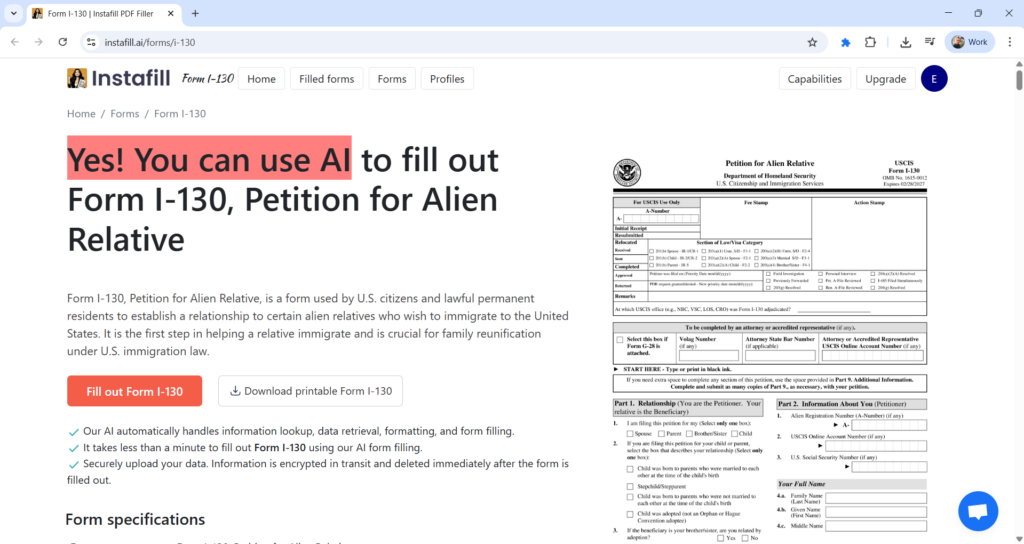
3. Form I-130, Petition for Alien Relative
Used by U.S. citizens and lawful permanent residents to establish family relationships for immigration purposes. This 12-page petition documents family relationships, biographical data for both petitioner and beneficiary, and supporting evidence.
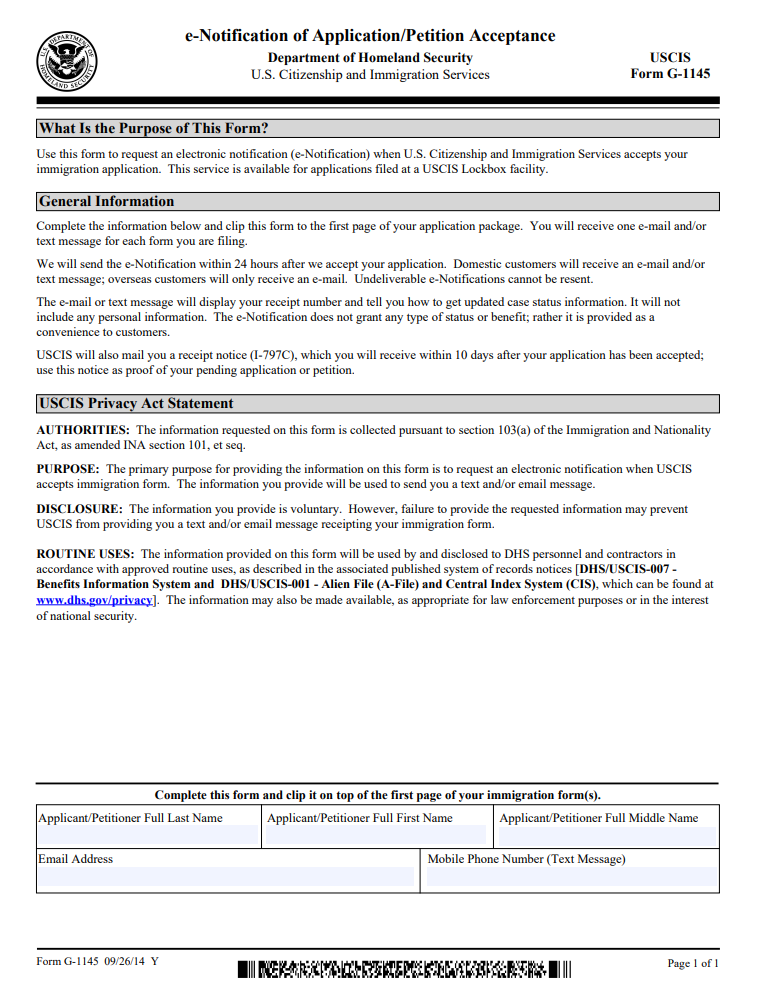
4. Form G-1145, E-Notification of Application/Petition Acceptance
This simple 1-page form requests email or text message notification when USCIS accepts an application or petition. Despite its brevity, it’s often overlooked in manual workflows but provides valuable case tracking.
Each form was fine‑tuned once and can now be filled on demand with data drawn from client profiles.
Why This Matters
For Immigration Attorneys
Operational efficiency from launch: New practices can start with modern infrastructure rather than adopting it years later. Hong’s approach demonstrates that solo attorneys don’t have to accept administrative burden as an inevitable part of practice.
Competitive positioning: A solo practitioner with efficient systems can compete with established firms on turnaround time and service quality. Technology becomes an equalizer rather than an advantage only large firms can afford.
Time allocation: Hours saved on form completion become hours available for client consultations, legal research, case strategy, and business development. For solo practitioners, this directly impacts both service quality and practice growth.
Scalability: When the practice is ready to grow, the infrastructure is already in place. Hiring additional attorneys or staff doesn’t require rebuilding operational systems.
For Clients
Faster processing: Applications can be completed and submitted more quickly when attorneys aren’t spending hours on manual data entry.
Higher accuracy: Automated systems reduce the risk of transcription errors, inconsistent information across forms, and missed fields that can trigger USCIS requests for evidence or rejections.
More attorney access: When attorneys spend less time on administrative work, they have more time available for client communication, case strategy, and addressing complex legal issues.
Key Takeaways
Automating immigration paperwork is no longer a “nice to have” for solo and small practices; it is a competitive necessity. Hong LLC’s experience shows how a modern AI form‑filling platform can deliver tangible benefits without requiring technical expertise. By combining reusable profiles, document extraction, rapid filling and secure data management, Instafill.ai turned a labour‑intensive process into a streamlined workflow. For immigration attorneys handling multiple USCIS forms per client, the resulting time savings, accuracy gains and improved client experience are profound.